Healthcare localization adapts a health platform's language, medical terminology, formatting, and safety cues so people can understand and share health information across languages. For Lunas One, that means more than translating buttons: we are designing a multilingual experience that keeps explanations in each person's preferred language while making critical details available in a consistent English representation when a cross-language clinical handoff requires it. This work is in development, and automated translation should never replace a qualified medical interpreter or professional review for high-stakes decisions.
What is healthcare localization?
Healthcare localization is the process of adapting a health product for a person's language and context while preserving the meaning of the medical information. Translation changes words from one language to another. Localization also accounts for medical terminology, dates, measurements, layout, reading direction, fallbacks, and the way safety guidance is presented. Interpretation is different again: it is the live spoken or signed communication between people.
That distinction matters because a fluent interface can still fail a patient. A label may fit the screen but use unfamiliar terminology. A translated result may be technically literal but unclear. A warning may lose emphasis when the sentence becomes longer in another language. Good multilingual healthcare design has to protect comprehension, not merely replace text.
Why does preferred-language medical information matter?
Medical information is already hard to understand. Patients should not also have to mentally translate lab results, explanations, instructions, or follow-up questions before they can make sense of what is happening with their health.
The CDC describes health literacy as the ability to find, understand, and use health information and recommends communicating in the audience's preferred language. It also warns that translated words can lose their intended meaning when language, culture, literacy, and context are not considered together. For a healthcare product, language access and plain language are therefore connected design responsibilities.
What happens when health information changes hands?
A patient may use Lunas One in Chinese, Spanish, Arabic, Filipino, or another language, but the information may later need to be reviewed by a doctor, nurse, EMT, pharmacist, specialist, caregiver, or medical team who uses a different language. Critical information should not become trapped in a single-language view.
Our design direction is to keep the person's preferred-language version while also making a consistent English representation available when it is needed for a cross-language handoff. The original should remain visible, the two representations should stay linked, and uncertainty should be explicit. This is not a substitute for a qualified interpreter: high-stakes communication still needs professional verification and clinical judgment.
Which medical details need extra consistency?
The cost of ambiguity rises when information must be scanned quickly, compared with another record, or acted on by someone new to the case. These are the details where terminology, units, formatting, and the relationship between language versions need especially careful handling:
- Allergies and adverse reactions
- Current medications, strength, and dosing instructions
- Diagnoses and medical history
- Lab results, units, reference ranges, and abnormal findings
- Procedures and previous treatments
- Care summaries and clinical handoffs
- Emergency information and critical alerts
How is Lunas One approaching multilingual healthcare?
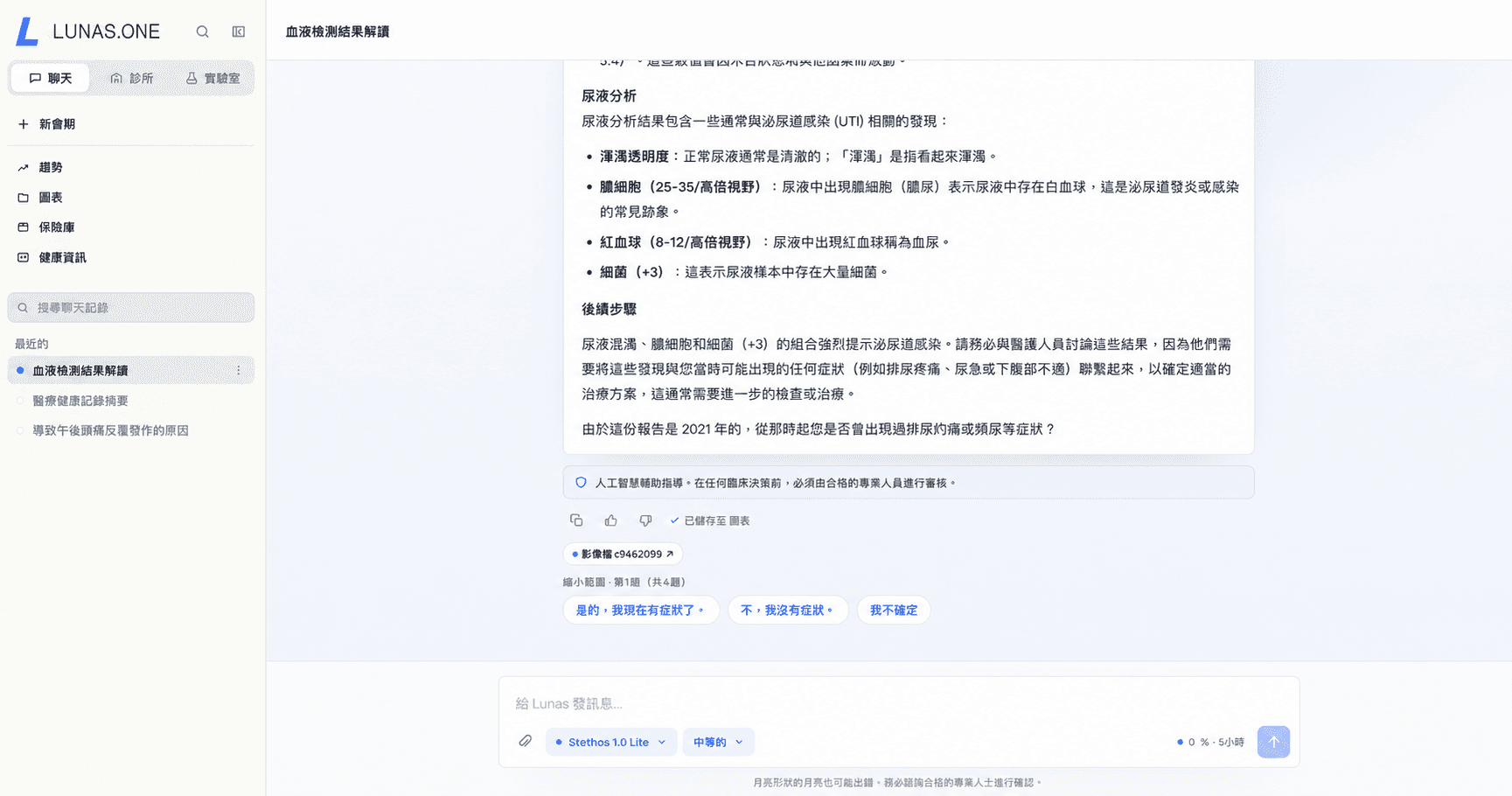
The work begins with the product details people notice only when they fail: consistent medical terminology, graceful language fallbacks, readable layouts across languages, and safety notices that remain prominent after translation. The work-in-progress image above shows a Traditional Chinese explanation of urinalysis findings, a reminder that a qualified professional must review clinical decisions, and follow-up questions in the same language.
The next layer is continuity. A translated explanation should not become a disconnected copy of the record. Important facts need a stable meaning as they move between a patient's preferred language and the language used by a care team. We are building and testing this one workflow at a time rather than treating automated translation as proof that the problem is solved.
Why a small localization detail can become a safety detail
Translation, terminology consistency, fallbacks, standardized critical information, and formatting can look like minor product decisions. Healthcare products are often judged by exactly these details when information has to be understood, shared, and acted on.
The big features get attention. The small details determine whether the information survives a change of language and a change of hands. In healthcare, localization is not only about making software easier to use. It is about helping preserve meaning—and knowing when technology must hand the conversation to a qualified human.
Common questions
- What is the difference between medical translation and healthcare localization?
- Medical translation converts health information from one written language to another. Healthcare localization is broader: it also adapts terminology, measurements, dates, layouts, reading direction, fallbacks, and safety cues for the people and setting where the product is used.
- Why keep critical health information in more than one language?
- A preferred-language version helps the patient understand their information, while a linked, consistent English representation can support review when a clinician or emergency professional uses a different language. Neither version should silently overwrite the other, and high-stakes details should be professionally verified.
- Can AI medical translation replace a qualified medical interpreter?
- No. AI can help make routine information more accessible, but it can miss context, ambiguity, cultural meaning, or specialized terminology. A qualified medical interpreter or translator and a healthcare professional remain essential for high-stakes communication and clinical decisions.
- Which languages does Lunas One support?
- Localization is still in development. The current work explores multilingual experiences including Chinese, Spanish, Arabic, Filipino, and other languages; this post is a design direction, not a promise that every workflow or language is already available in production.
Sources and further reading
- Culture and Language — US Centers for Disease Control and Prevention
- What Is Health Literacy? — US Centers for Disease Control and Prevention
- Address Language Differences: Tool 9 — Agency for Healthcare Research and Quality
- Multilingual healthcare communication: Stumbling blocks, solutions, recommendations — Patient Education and Counseling (PubMed)
Follow what we are building in Lunas
Localization is still in development. You can start using Lunas today for everyday medical questions while we continue testing multilingual workflows with professional review in mind.
Get Started